Cast on enough stitches for a hat, join them into a ring, and something shifts in the way the knitting feels. There is no wrong side to purl, no seam to sew at the end, no stockinette panel curling up like a scroll. You simply go around, and a tube grows under your hands. That is the appeal of circular knitting, and it is why most hats, socks, and sweaters are made this way.
The catch is that "knitting in the round" is not one technique. It is three, and the tools look nothing alike. Here is how each one works, and how to tell which belongs in your hands.
Why Knit in a Circle at All?
Flat knitting makes rectangles that you sew together. Circular knitting makes the finished shape directly, which saves a surprising amount of time. There is no seaming, no seam bulk under the arm, and no purling when you want plain stockinette. You can try a sweater on as you go instead of waiting until the pieces are joined, which catches length and fit problems early.
Stripes line up without matching row counts, colourwork charts stay readable because you always face the right side, and the fabric has an even tension across its width. The trade-off is that you cannot easily work a shaped flat piece, so cardigans with button bands are often knitted flat or steeked later. For pullovers, hats, and socks, working in the round is the default for good reason.
Circular Needles: Two Tips, One Cable
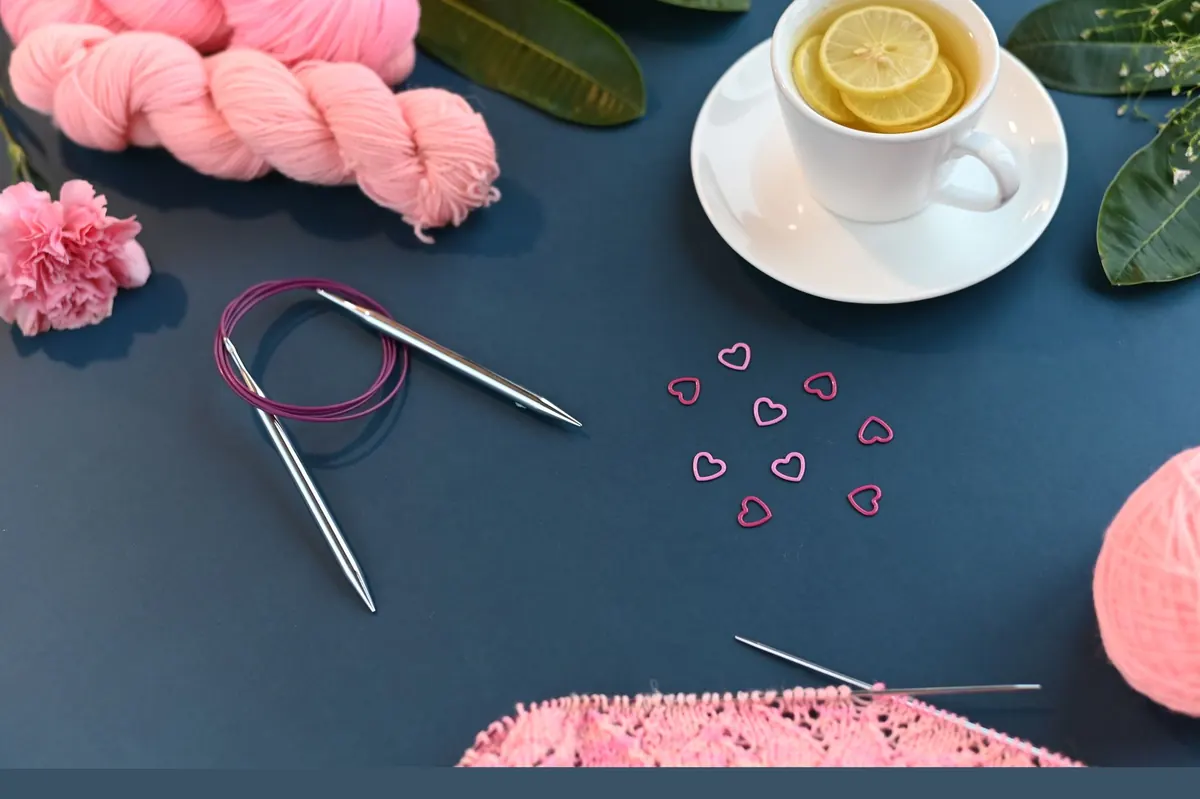
A circular needle is two short tips joined by a flexible cable. The stitches travel around the cable, and you knit from one tip to the other. The one rule that matters most: the needle must be shorter than the circumference of the tube you are making. If the cable is longer than your work, the stitches stretch along it, and your gauge goes wrong in a way that does not show up until the piece is finished.
A 16-inch (40 cm) circular handles most adult hat bodies. A 32-inch (80 cm) or longer circular is comfortable for sweater bodies and yokes, where you have hundreds of stitches to spread out. Fixed circulars come in a single size; interchangeable sets let you swap tips on the same cable, which is cheaper over time and easier to store.
Circulars can also knit flat. Cast on, work a row, then turn the work at the end of each row exactly as you would with straight needles. Many knitters gradually replace their straight needles with one or two long circulars.
Magic Loop: One Long Cable for Everything
Magic loop uses a single long circular needle, usually 32 to 40 inches (80 to 100 cm), to knit tubes far smaller than the cable. You divide the stitches into two halves and pull a loop of cable out at each side, so the halves sit on their own short sections of cable. The steps are simple once you have done them a few times.
- Cast on and slide all the stitches to the middle of the cable.
- Find the halfway point. Pull a loop of cable out between the two halves.
- Slide the front half of the stitches up onto the left needle tip, and the back half down onto the cable.
- Knit across the front half, then rotate the work and repeat on the second half.
The loop position moves as you work, which keeps it from wearing one spot on the cable. Magic loop shines for socks, mittens, sleeve cuffs, and anything with a small circumference, because one needle covers every size you own. The familiar complaint is ladders: loose columns of stitches where the halves meet. Give the first stitch a firm tug and the second stitch an extra snug, and the gaps close up.
Double-Pointed Needles: The Classic Small-Circumference Tool
Double-pointed needles, or DPNs, come in sets of four or five short needles. You divide the stitches across all but one needle, then use that free needle to knit the next section, rotating the work as each needle empties. Nothing is joined except the knitting itself, so nothing can be the wrong length.
They are the traditional tool for socks and mittens, and many knitters find them quick once the initial juggling stops feeling like handling cutlery for the first time. Bamboo and wood have more grip, which helps with slippery yarn; metal is faster and better for tight gauges. If you drop a stitch, DPNs let you see exactly where it went, which is more than can be said for a cable crowded with stitches.
Ladders appear here too, at the points where you change needles. Shift the transition point by a stitch or two every few rounds so the loose columns never stack up in the same place.
Matching the Method to the Project
- Hats: a 16-inch circular for the body, then switch to DPNs or magic loop for the crown, once the tube is too small for the cable.
- Socks: magic loop or DPNs throughout. The heel turn is the fiddly part, and both methods cope with it fine.
- Sweater bodies and yokes: a long circular. On a yoke, you may need two cable lengths as the stitch count grows and shrinks.
- Sleeves: magic loop, DPNs, or two short circulars worked as a pair. Pick whichever you already have.
- Tiny things — thumbs, i-cord, baby mitts: DPNs or magic loop. No 16-inch circular will manage them.
Three Problems That Trip Up Beginners
The twist
When you join a cast-on into a ring, every stitch must face the same way. If one section spirals around the needle, you have knitted a Möbius strip and there is no fixing it later. Before joining, lay the cast-on edge flat on a table and check that the bumps all line up along one straight line. Then work the first round slowly.
Ladders at the joins
Loose columns at needle changes come from a slack first stitch and a stretched gap between needles. Hold the working yarn firmly for the first two stitches of each new section, or use a needle one size smaller for those stitches. Consistent tension beats any trick, and it arrives with practice.
Wrong cable length
If the tube fights back, pulling taut and refusing to relax, the cable is probably too long. Go down a cable size, or switch to magic loop until the piece grows. This is a tool problem, not a skill problem, and it is worth changing needles rather than forcing the knitting.
Start Small, Then Trust the Tube
Pick one method and give it a whole project, not a swatch. Cast on a worsted-weight hat on a 16-inch circular, join carefully, and knit a few inches of plain stockinette. Or cast on a sock in magic loop and accept that the first two rounds will feel clumsy. Your hands adapt faster than you expect, usually within an evening.
Keep one long circular and a set of DPNs in your bag and you can knit nearly anything round: hats, socks, sleeves, yokes, mittens. The best method is not the one other knitters prefer. It is the one that keeps you going around, round after round, until the tube is finished.
Photo: Knitting Needles / Pexels